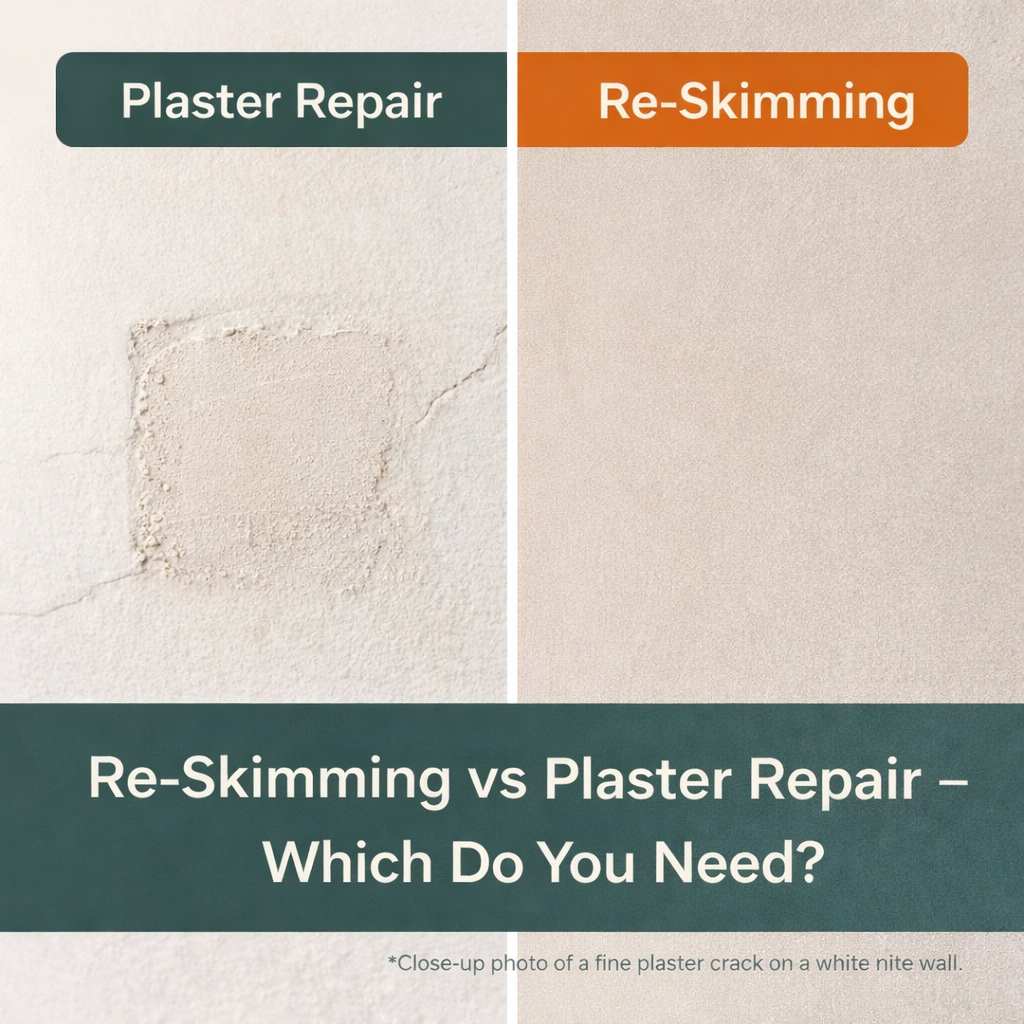
If your walls or ceilings are cracked, uneven or damaged, you might be wondering whether a simple plaster repair will fix the issue — or whether a full re-skim is the better option.
The right solution depends on the condition of the surface and the overall finish you’re aiming for.
Here’s how to decide.
What Is Plaster Repair?
Plaster repair focuses on specific damaged areas.
It’s usually suitable for:
- Hairline cracks
- Small blown patches
- Minor ceiling joint cracks
- Areas damaged by plumbing or electrical work
- Localised water damage (once fully dry)
The goal is to repair and blend the damaged section so it matches the surrounding surface.
Plaster repair is often more cost-effective when the majority of the wall or ceiling is still in good condition.
What Is Re-Skimming?
Re-skimming involves applying a thin, smooth layer of fresh plaster over an entire wall or ceiling.
This is usually recommended when:
- Surfaces are heavily marked or uneven
- Previous repairs are visible
- Artex or textured finishes need covering
- Multiple cracks are present across the surface
- You want a fresh, modern smooth finish
Re-skimming creates a consistent finish across the whole area rather than repairing isolated sections.
When Plaster Repair Is Usually Enough
You likely only need repair work if:
- Cracks are limited to a few areas
- The rest of the wall is smooth
- Damage is localised
- You’re redecorating one section
In many new build homes, small settlement cracks can be professionally repaired without the need for full re-skimming.
When Re-Skimming Makes More Sense
Re-skimming may be the better choice if:
- There are multiple visible patches
- Surfaces are uneven or previously poorly repaired
- You’re fully renovating a room
- You want a uniform, fresh finish
Sometimes homeowners initially plan small repairs but later decide re-skimming provides a better long-term result.
Cost Comparison
Generally:
- Plaster repair is lower cost for small, isolated areas
- Re-skimming costs more upfront but delivers a fully refreshed surface
You can read more about typical pricing in my guide.
How to decide which you need
As a rule of thumb, a few isolated patches — a cracked corner, a hole after a removed fitting, a small area of blown plaster — call for a plaster repair. Widespread cracking, a tired wall that has been patched many times, or artex you want gone all point towards a re-skim, where the whole wall gets a fresh top coat. If you are unsure, a quick photo is usually enough for me to tell you which makes sense.
Why a re-skim sometimes works out better
Lots of individual patch repairs can end up looking mismatched, with slightly different textures catching the light across the wall. A single skim coat over the whole wall gives one uniform, flat surface ready to decorate — often the better-value choice once a wall needs more than a couple of repairs. There is more on my plastering services page.
Plastering Services in Blackburn
If you’re unsure whether you need plaster repair or full re-skimming, feel free to send photos and details.
I provide both plaster repairs and re-skimming services across Blackburn and surrounding areas.
For more information, visit my Plastering Services page.